
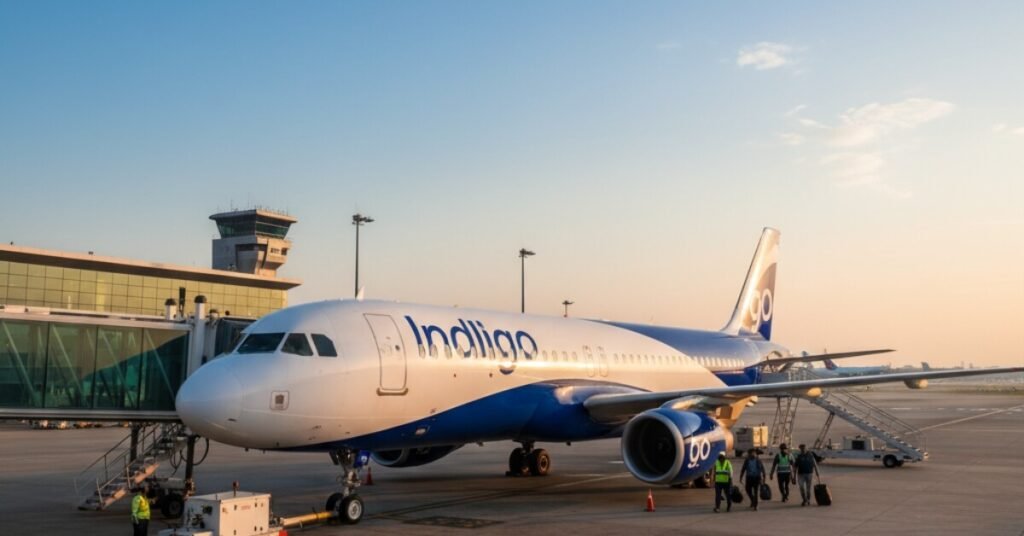
In recent days, social media platforms and news-sharing groups have been flooded with alarming claims that an IndiGo flight from Jeddah to Hyderabad was diverted to Mumbai because a “human bomb” was found onboard.
While the flight diversion did occur, the viral message about a “human bomb” is false and misleading. This blog clarifies what actually happened, based on verified sources and official aviation statements, to help readers separate fact from fear.
What Actually Happened
On November 1, 2025, IndiGo flight 6E-68 operating between Jeddah (Saudi Arabia) and Hyderabad (India) received precautionary orders to divert to Mumbai after Rajiv Gandhi International Airport (RGIA) in Hyderabad received a threat email.
The email claimed there was a “human bomb” onboard the flight and warned airport officials not to allow the aircraft to land at Hyderabad.
Following standard aviation security protocol, the Bomb Threat Assessment Committee (BTAC) immediately activated its emergency response procedures. As a safety measure, the flight was diverted to Mumbai for a detailed inspection.
Security Checks and Findings
Upon landing in Mumbai, the aircraft was thoroughly inspected by the CISF (Central Industrial Security Force), airport security teams, and Mumbai Police.
Every passenger, baggage, and cargo compartment underwent rigorous screening. After hours of detailed examination, no suspicious items, explosives, or evidence of any “human bomb” were found.
Authorities officially declared the threat as a hoax — a false alarm that had triggered a necessary but precautionary response.
The “Human Bomb” Story — A Case of Misinformation
Soon after the diversion, several social media pages, messaging platforms, and online groups began circulating sensational messages claiming that a “human bomb” was detected onboard the IndiGo flight.
This rumour spread rapidly, creating unnecessary panic among passengers and the general public.
However, no credible authority or aviation body confirmed the presence of any bomb, human or otherwise. The Directorate General of Civil Aviation (DGCA), IndiGo Airlines, and airport security officials have all stated that the incident was a security precaution triggered by a threat email, not an actual bomb discovery.
Such false narratives not only cause fear but also undermine the trust in India’s civil aviation security systems — which, in reality, acted swiftly and responsibly in this situation.
Why False Threats Are Increasing in Indian Aviation
The IndiGo Jeddah–Hyderabad diversion isn’t an isolated case. In recent months, India has seen a surge in fake bomb threats targeting airlines and airports across the country.
Key points:
- These threats are mostly sent via anonymous emails or social media accounts.
- Almost all such warnings have turned out to be non-credible after investigation.
- Authorities believe these are often prank emails, cyber harassment attempts, or coordinated misinformation campaigns.
According to security experts, these hoaxes aim to cause fear, disruption, and confusion, leading to costly diversions, passenger anxiety, and delayed operations.
How Aviation Authorities Handle Threat Emails
India’s aviation sector operates under a strict security framework designed by the Bureau of Civil Aviation Security (BCAS).
Whenever an airport or airline receives a threat message:
- The Bomb Threat Assessment Committee (BTAC) is immediately informed.
- The flight is diverted, isolated, or delayed depending on the risk level.
- Security forces conduct complete searches of the aircraft, passengers, and luggage.
- The cybercrime unit traces the origin of the threat email for criminal investigation.
In this case, every step was followed perfectly — ensuring the safety of passengers while verifying the authenticity of the claim.
Official Clarification: No Human Bomb Found
After thorough investigation, it was confirmed that:
✅ The threat email was false.
✅ No bomb or explosive device was detected onboard.
✅ The aircraft and all passengers were declared safe.
✅ The flight later continued its journey to Hyderabad after clearance.
This clearly proves that the viral “human bomb” story is fake news, spreading misinformation and panic unnecessarily.
Why It’s Important to Verify Before Sharing
The rapid spread of false information can be as dangerous as an actual threat. Misinformation can:
- Create public fear and chaos.
- Damage the reputation of airlines and airports.
- Divert critical security resources from genuine threats.
As responsible citizens, it’s vital to rely only on official statements from credible sources such as the DGCA, BCAS, airport authorities, or the airline’s verified handles before sharing or reacting to such news.
Conclusion
The recent incident involving the IndiGo Jeddah–Hyderabad flight diversion was a routine security precaution in response to a threat email — not a confirmed terror or bomb situation.
No “human bomb” was ever found onboard.
This case highlights the efficiency of India’s aviation safety system, which acted swiftly and responsibly to ensure passenger security.
At the same time, it underscores the urgent need to combat misinformation and promote factual awareness in aviation news.